Published by Garvin Accounting Solutions | Making Tax Season Less Painful for Florida Entrepreneurs
Alright, let’s talk about something that catches way too many Florida business owners off guard: quarterly estimated taxes.
I can’t tell you how many times I’ve had a panicked business owner walk into my office in April saying, “I owe HOW MUCH?!” followed by, “Can I just pay it later?”
Spoiler alert: the IRS doesn’t care that you didn’t know about quarterly payments. They don’t care that you’re a new business owner. And they definitely don’t care that you’d rather be at Clearwater Beach than dealing with tax forms.
But here’s the good news: once you understand how quarterly estimated taxes work, they’re actually not that scary. And I’m going to break it down for you in plain English—no accounting jargon, no confusing IRS-speak, just straight talk from someone who’s been helping Florida business owners navigate this stuff for years.
What the Heck Are Quarterly Estimated Taxes?
Let’s start with the basics.
If you’re a W-2 employee, taxes get automatically withheld from every paycheck. Easy, right? Your employer handles it, and by the end of the year, you’ve (hopefully) paid enough to cover your tax bill.
But when you’re self-employed or own a business? Nobody’s withholding taxes for you.
That’s where quarterly estimated taxes come in. The IRS wants their money throughout the year—not all at once in April. So they require you to estimate your annual income and pay taxes in four installments.
Think of it like this: instead of one massive tax bill that makes you want to cry into your Cuban coffee, you’re making smaller payments throughout the year. It’s the IRS’s version of a payment plan, except it’s mandatory.
Who Needs to Pay Quarterly Estimated Taxes in Florida?
Here’s who the IRS expects to make quarterly payments:
✅ Self-employed individuals (freelancers, consultants, contractors) ✅ Sole proprietors ✅ LLC owners (single-member or multi-member) ✅ S-Corporation shareholders (who don’t withhold enough from their salaries) ✅ Partnership partners ✅ Anyone who expects to owe $1,000+ in taxes when they file
The Florida Advantage:
Remember, Florida has no state income tax. This means you’re only dealing with federal quarterly payments (and self-employment tax). Compare that to business owners in California or New York who have to juggle both federal AND state quarterly payments—we’ve got it easier, folks!
Real Talk:
If you made decent money last quarter from your Miami consulting business, Tampa food truck, Orlando Etsy shop, or Jacksonville contracting company—you probably need to be paying quarterly taxes. Ignorance isn’t bliss when the IRS comes calling with penalties and interest.
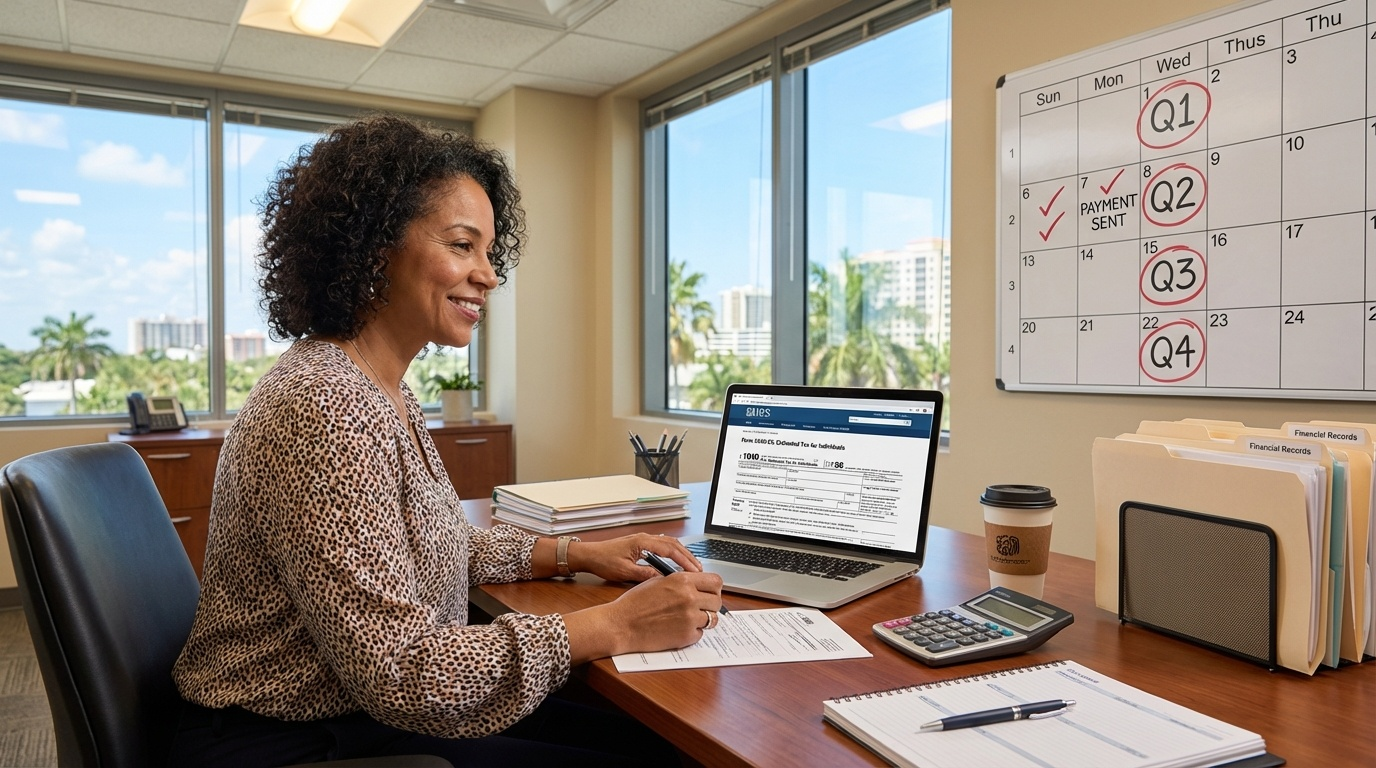
The 2025 Quarterly Tax Deadlines (Mark Your Calendar NOW)
Here are the dates you absolutely cannot miss in 2025:
| Quarter | Income Period | Payment Due Date |
|---|---|---|
| Q1 2025 | January 1 – March 31 | April 15, 2025 |
| Q2 2025 | April 1 – May 31 | June 16, 2025 |
| Q3 2025 | June 1 – August 31 | September 15, 2025 |
| Q4 2025 | September 1 – December 31 | January 15, 2026 |
Pro Tips:
- Set phone reminders two weeks before each deadline
- Better yet, set up automatic payments through IRS Direct Pay or EFTPS
- If the deadline falls on a weekend or holiday, it moves to the next business day
- Missing a deadline = penalties + interest (we’ll talk about that nightmare later)
Hurricane Season Consideration:
Florida business owners, listen up: if a hurricane or natural disaster hits and the IRS declares your area a disaster zone, deadlines may be extended. But don’t count on Mother Nature to save you from quarterly taxes—always plan to pay on time.
How to Calculate Your Quarterly Estimated Tax Payments
This is where most Florida business owners get intimidated. But I promise, it’s simpler than parallel parking a boat trailer.
Method 1: The Safe Harbor Method (AKA “Play It Safe”)
The IRS has a “safe harbor” rule that protects you from underpayment penalties. Here’s how it works:
Pay the LESSER of:
- 100% of last year’s total tax liability, OR
- 90% of this year’s estimated tax liability
Special rule for high earners: If your 2024 Adjusted Gross Income (AGI) was over $150,000 ($75,000 if married filing separately), you need to pay 110% of last year’s tax to meet safe harbor.
Example:
Let’s say you’re a Fort Myers wedding photographer. Your 2024 total tax liability was $20,000.
For 2025, using the safe harbor method:
- Annual safe harbor amount: $20,000
- Quarterly payment: $20,000 ÷ 4 = $5,000
Pay $5,000 by each quarterly deadline, and you’re protected from underpayment penalties—even if you end up owing more in April.
Method 2: The Actual Income Method (AKA “I Like to Live Dangerously”)
This method requires you to estimate your actual 2025 income and calculate 90% of your expected tax liability.
Steps:
- Estimate your 2025 gross income
- Subtract business deductions (home office, equipment, supplies, etc.)
- Calculate your taxable income
- Apply your tax rate (2025 federal tax brackets)
- Add self-employment tax (15.3% on net earnings)
- Multiply total by 90%
- Divide by 4 for quarterly amount
Example:
You own a Tampa digital marketing agency. You estimate:
- Gross income: $200,000
- Business deductions: $50,000
- Net business income: $150,000
Income tax calculation:
- Apply 2025 tax brackets (let’s say effective rate ~18%): $27,000
- Self-employment tax (15.3% × $150,000 × 92.35%): $21,200
- Total estimated tax: $48,200
- 90% safe harbor: $43,380
- Quarterly payment: $43,380 ÷ 4 = $10,845
The Risk:
If your income ends up higher than estimated, you might face underpayment penalties. That’s why many business owners prefer the safe harbor method—it’s predictable.
Method 3: The Annualized Income Method (For Seasonal Florida Businesses)
This one’s perfect for Florida’s seasonal businesses—think tourism, hospitality, event planning, landscaping.
If your income fluctuates wildly by quarter (summer tourism boom vs. slow fall season), you can calculate each quarterly payment based on your actual income for that period.
Example:
You own a Key West tour boat business:
- Q1: Slow season, $15,000 net income → smaller tax payment
- Q2: Peak snowbird season, $80,000 net income → larger tax payment
- Q3: Hurricane season slowdown, $10,000 net income → smaller payment
- Q4: Holiday uptick, $45,000 net income → moderate payment
You’d calculate each quarter’s payment based on actual earnings, not just dividing annual estimates by four.
The Catch:
This method requires filing Form 2210 (Schedule AI) with your tax return to prove your income was uneven. More paperwork, but potentially significant cash flow benefits.
How to Actually MAKE Your Quarterly Tax Payments
Okay, you’ve calculated your payment. Now what? Here are your options:
Option 1: IRS Direct Pay (FREE and Easy)
- Go to IRS.gov/payments
- Pay directly from your checking or savings account
- Free, secure, confirmation number provided
- Can schedule payments in advance
Best for: One-time payments, business owners who like control
Option 2: EFTPS (Electronic Federal Tax Payment System)
- Enroll at eftps.gov
- Takes 5-7 business days to activate
- Schedule payments up to 365 days in advance
- Track payment history
Best for: Business owners who want to set-it-and-forget-it
Option 3: Mail a Check (Old School)
- Use IRS Form 1040-ES payment vouchers
- Mail to the IRS address for Florida (check IRS.gov for current address)
- Include the voucher with your check
- Mail at least 5-7 days before deadline
Best for: People who don’t trust technology (or enjoy stamp collecting)
Option 4: Pay Through Your Tax Software
- QuickBooks, TurboTax, H&R Block, etc.
- Often charge a small processing fee
- Convenient if you’re already using the software
Best for: Business owners already using accounting software
Option 5: Credit/Debit Card (Convenience Fee Applies)
- Use IRS-approved payment processors
- Typically 1.85% – 2.5% convenience fee
- Might be worth it if you earn rewards points
Best for: Cash flow crunches or rewards chasers (do the math first!)
Pro Tip from Garvin Accounting:
Set up EFTPS and schedule all four quarterly payments at the beginning of the year. Put it on autopilot and forget about it. Your future self will thank you.
What Happens If You Don’t Pay Quarterly Taxes?
Let’s talk about the consequences, because they’re real and they hurt.
Underpayment Penalty
If you don’t pay enough throughout the year, the IRS charges an underpayment penalty. This is calculated based on:
- How much you underpaid
- How long you underpaid
- The IRS interest rate (changes quarterly, typically 5-8%)
Real-World Example:
Miami boutique owner doesn’t pay any quarterly taxes. She owes $30,000 at tax time.
- Underpayment penalty: Approximately $1,200 – $1,800 (depending on IRS rates)
- Plus interest on the late payment
- Total extra cost: $1,500 – $2,500+
That’s money down the drain that could’ve been reinvested in her business.
Interest Charges
Even if you file for an extension, interest starts accruing immediately on unpaid taxes. The IRS compounds interest daily. Yes, daily.
Failure-to-Pay Penalty
Don’t pay by the tax deadline? The IRS adds a failure-to-pay penalty of 0.5% per month (up to 25% of unpaid taxes).
The Bottom Line:
Paying quarterly isn’t optional if you meet the requirements. The penalties and interest will cost you way more than just paying on time.
Special Situations for Florida Business Owners
You’re in Your First Year of Business
Good news! If you had no tax liability last year (because your business didn’t exist), you’re not required to make quarterly payments for your first year.
BUT—and this is important—you should still consider making them to avoid a massive tax bill in April.
Smart Move:
Once you have a few months of income data, estimate your annual profit and start making voluntary quarterly payments. Your April-self will be grateful.
You Have a Side Hustle + W-2 Job
Let’s say you work full-time at a Tampa hospital but also run a side photography business that brings in $30,000/year.
Options:
- Make quarterly payments on your side hustle income
- Increase W-2 withholding to cover both jobs (adjust your W-4 with your employer)
Most people find option #1 cleaner—keeps side business finances separate.
Your Income Varies Wildly (Welcome to Entrepreneurship!)
Florida business income can be unpredictable. Some quarters you’re crushing it; others you’re scraping by.
Strategy:
- Use the safe harbor method for predictability
- Or use the annualized method and adjust each quarter
- Keep a “tax savings account” and deposit 25-30% of each payment you receive
You’re an S-Corp Owner
If you’ve elected S-Corp status (smart move for many Florida businesses), you’re paying yourself a salary with taxes withheld.
But—you might still need quarterly payments if:
- Your salary withholding isn’t enough to cover your full tax liability
- You’re taking significant distributions beyond salary
- You have other income sources
Example:
Orlando consultant structured as S-Corp:
- Salary: $60,000 (taxes withheld)
- Distributions: $40,000 (no withholding)
- Other income: Rental property, dividends
She’ll likely need quarterly payments to cover taxes on distributions and other income.
Tax Planning Strategies to Reduce Quarterly Payments
Now let’s talk about the fun stuff—how to legally pay less.
Strategy 1: Maximize Business Deductions
The more legitimate business expenses you deduct, the lower your taxable income, the lower your quarterly payments.
Common Florida Business Deductions:
- Home office (if you work from home)
- Vehicle expenses (mileage or actual expenses)
- Business meals (50% deductible)
- Professional development and education
- Software and subscriptions
- Marketing and advertising
- Insurance premiums
- Professional fees (legal, accounting, consulting)
Real Example:
Jacksonville graphic designer nets $80,000. She maximizes deductions:
- Home office: $6,000
- Equipment: $4,000
- Software subscriptions: $3,000
- Professional development: $2,000
- Total deductions: $15,000
- New net income: $65,000
This reduces her quarterly tax payments by approximately $1,000 per quarter.
Strategy 2: Increase Retirement Contributions
Contributions to SEP IRA, Solo 401(k), or SIMPLE IRA reduce your taxable income.
Example:
Sarasota consultant making $120,000 contributes $30,000 to Solo 401(k):
- Reduces taxable income to $90,000
- Saves approximately $7,200 in taxes (24% bracket)
- Quarterly payment reduction: $1,800 per quarter
You’re building retirement wealth AND reducing tax liability. Win-win.
Strategy 3: Income Smoothing
If you have control over when you invoice or collect payments, consider smoothing income across quarters to avoid pushing yourself into higher tax brackets.
Caution: Don’t manipulate income purely for tax purposes—base decisions on legitimate business reasons. But strategic timing? Totally legal.
Strategy 4: Leverage Tax Credits
- Health insurance tax credit (if you’re self-employed)
- Research & Development credit (for innovative businesses)
- Work Opportunity Tax Credit (hiring from certain groups)
- Disabled Access Credit (making your business accessible)
Tax credits directly reduce your tax liability dollar-for-dollar—even better than deductions.
Common Quarterly Tax Mistakes Florida Business Owners Make
Let me save you from these painful errors I see every year:
❌ Mistake #1: Forgetting About Self-Employment Tax
Many business owners calculate only income tax and forget about the 15.3% self-employment tax (Social Security + Medicare).
This is a killer. On $100,000 net income, that’s an additional $15,300 in taxes.
Solution: Always include self-employment tax in your calculations.
❌ Mistake #2: Not Adjusting When Income Changes
Your business took off mid-year? Congrats! But if you’re still making quarterly payments based on last year’s lower income, you’re in for a nasty April surprise.
Solution: Recalculate quarterly payments whenever income significantly changes.
❌ Mistake #3: Missing Deadlines
“I forgot” doesn’t fly with the IRS. Mark those quarterly deadlines in every calendar you own.
Solution: Set up automatic payments or calendar reminders with two-week advance notice.
❌ Mistake #4: Not Keeping Records
Come tax time, you can’t remember what you paid, when you paid it, or why.
Solution: Keep confirmation numbers, save payment receipts, track everything in accounting software.
❌ Mistake #5: Mixing Personal and Business Finances
Trying to calculate quarterly taxes when your business and personal expenses are jumbled together? Good luck with that.
Solution: Separate bank accounts and credit cards for business. Non-negotiable.
❌ Mistake #6: Underpaying Because “I’ll Catch Up Later”
No you won’t. And the penalty will hurt.
Solution: Pay what you owe when you owe it. Create a tax savings account and treat it like a bill.
How to Set Up a “Tax Savings Account” System
This is hands-down the best advice I can give Florida business owners:
The System:
- Open a separate high-yield savings account (call it “Tax Savings” or “IRS Fund”)
- Every time you receive a payment, immediately transfer 25-30% to this account
- Never touch this money except to pay quarterly taxes
- Watch it grow throughout the quarter
- When quarterly deadline hits, you’ve got the cash ready
The Math:
Let’s say you’re a Naples wedding planner. You receive a $5,000 payment from a client.
Immediately transfer:
- $5,000 × 30% = $1,500 to tax savings account
Do this with every payment, and when quarterly taxes are due, you’re covered.
Why This Works:
- Cash flow management: Never scrambling to pay taxes
- Peace of mind: Money’s already set aside
- Avoid penalties: You’ll always have enough to pay on time
- Bonus: If you overestimate, you get a refund (or keep it for next quarter)
Pro Tip:
Use a high-yield savings account (many online banks offer 4-5% interest). Your tax savings can earn interest while waiting for quarterly deadlines.
What If You Can’t Afford Your Quarterly Payment?
Real talk: sometimes cash flow is tight. Maybe hurricane season crushed your tourism business. Maybe a major client didn’t pay on time. Life happens.
Option 1: Pay What You Can
Paying something is better than paying nothing. The penalty and interest will be lower.
Option 2: Request a Payment Plan
The IRS offers short-term (120 days or less) and long-term payment plans. Apply online or call.
Option 3: Adjust Future Payments
If Q1 was tough, you can recalculate using the annualized income method and pay less (legally).
Option 4: Consult a Tax Professional
This is where having an accountant like Garvin Accounting Solutions comes in clutch. We can help you:
- Negotiate with the IRS
- Set up payment plans
- Identify deductions you might’ve missed
- Create a catch-up strategy
What NOT to Do:
- Ignore it and hope it goes away (it won’t)
- Use business funds to pay personal expenses instead of taxes
- Assume you’ll “deal with it in April”
The IRS is surprisingly flexible if you communicate proactively. Ghosting them? That’s when things get ugly.
Quarterly Taxes for Different Florida Business Types
Freelancers & Consultants
Typical situation: Variable income, home-based, minimal overhead
Best approach:
- Safe harbor method for simplicity
- Automate savings (30% of each payment)
- Maximize home office deduction
E-Commerce & Online Businesses
Typical situation: Can operate from anywhere in Florida, inventory considerations
Best approach:
- Track quarterly revenue carefully
- Factor in cost of goods sold
- Consider annualized method if sales are seasonal
Service-Based Businesses (Salons, Gyms, Cleaning Services)
Typical situation: Steady local clientele, predictable income
Best approach:
- Safe harbor method works well
- Regular quarterly payments
- Factor in Florida business taxes and licensing fees
Food & Beverage (Restaurants, Food Trucks, Catering)
Typical situation: High volume, lower margins, seasonal fluctuations
Best approach:
- Annualized method if seasonal
- Set aside percentage of daily sales
- Account for high operating expenses
Construction & Contracting
Typical situation: Project-based, large sporadic payments, equipment heavy
Best approach:
- Pay quarterly when receiving large project payments
- Maximize equipment depreciation (Section 179)
- Plan around hurricane season slowdowns
Real Estate Professionals
Typical situation: Commission-based, unpredictable closing schedules
Best approach:
- Set aside percentage of each commission immediately
- Annualized method might work better
- Don’t forget to account for self-employment tax
Tools & Resources for Managing Quarterly Taxes
Accounting Software
QuickBooks Online:
- Tracks income and expenses
- Estimates quarterly taxes
- Integrates with tax payment systems
FreshBooks:
- Great for freelancers
- Expense tracking
- Tax estimate calculator
Xero:
- Cloud-based
- Real-time financial data
- Multi-currency (good for international clients)
Tax Payment Platforms
- IRS Direct Pay (free)
- EFTPS (free, best for automation)
- TurboTax (if you’re using their software)
Calculators & Estimators
- IRS Tax Withholding Estimator (irs.gov)
- QuickBooks Tax Calculator
- Self-Employment Tax Calculator (various free online options)
Apps for Tracking
- Keeper Tax (finds tax deductions automatically)
- Hurdlr (mileage and expense tracking)
- Everlance (automatic mileage logging)
When to Hire a Tax Professional
Look, I’m obviously biased here. But let me give you the honest truth about when DIY makes sense and when you need professional help.
You Can Probably DIY If:
- Your business is very simple (straightforward freelancing)
- Income is consistent and predictable
- You have minimal deductions
- You’re comfortable with basic math and IRS forms
- Your tax situation hasn’t changed
You Should Hire a Pro If:
- Your business is growing rapidly
- You have employees or contractors
- You’re considering changing business structure
- You have multiple income streams
- You operate in multiple states
- You’ve received an IRS notice
- You want to maximize deductions and minimize liability
- You value your time and sanity
The ROI of Hiring an Accountant:
A good accountant (like the team at Garvin Accounting) typically saves you 3-10x their fee through:
- Identifying missed deductions
- Avoiding costly penalties
- Strategic tax planning
- Time saved (that you can spend growing your business)
Real Example:
Tampa photographer pays Garvin Accounting $2,500/year for accounting and tax services. We:
- Identify $8,000 in additional deductions
- Help her avoid $1,200 in penalties
- Save her 40+ hours of stress and confusion
- Total value: $12,000+
- ROI: 5x the investment
Not too shabby, right?
Your Quarterly Tax Checklist
Two Weeks Before Each Deadline:
□ Review income for the quarter □ Calculate deductions and expenses □ Determine quarterly payment amount □ Check bank account balance □ Set up payment (if not already automated)
One Week Before Deadline:
□ Double-check calculation □ Verify payment method is ready □ Confirm IRS payment address (if mailing) □ Gather any supporting documentation
On Payment Day:
□ Submit payment through chosen method □ Save confirmation number □ Record payment in accounting software □ Update tax planning spreadsheet □ Mark next quarter’s deadline on calendar
After Payment:
□ Monitor bank account for payment clearing □ File confirmation in tax records □ Update cash flow projections □ Celebrate! 🎉 (You’ve adulted successfully)
Final Thoughts: Making Peace with Quarterly Taxes
Here’s the thing about quarterly estimated taxes: they’re never going to be fun. Nobody wakes up excited to send money to the IRS.
But you know what’s even less fun? A massive, unexpected tax bill in April that wipes out your business savings. Penalties and interest that could’ve been avoided. The stress of owing money you don’t have.
Quarterly taxes are actually doing you a favor—they spread out the pain, help you budget, and keep you from getting blindsided.
And here in Florida, we’ve got it pretty good. No state income tax means we’re only juggling federal payments. Our business-friendly environment, year-round sunshine, and lack of state tax burden make Florida one of the best places to run a business.
Don’t let quarterly taxes intimidate you. Set up your system, automate what you can, and if you need help—reach out to professionals who actually care about keeping more money in your pocket.
Let Garvin Accounting Solutions Take the Stress Out of Quarterly Taxes
Look, you didn’t start your Florida business to become a tax expert. You started it because you’re passionate about what you do—whether that’s creating amazing food, building websites, planning events, or providing services that make people’s lives better.
The tax stuff? That’s where we come in.
At Garvin Accounting Solutions, we help Florida business owners just like you:
✅ Calculate accurate quarterly estimated payments ✅ Set up automated payment systems ✅ Maximize deductions throughout the year ✅ Avoid penalties and interest ✅ Plan strategically for tax season ✅ Actually understand what the heck is going on with your taxes
We don’t wear stuffy suits. We don’t speak in confusing jargon. We’re real people who genuinely care about helping you keep more of your hard-earned money.
Serving Florida business owners from:
- Miami to Jacksonville
- Tampa to Tallahassee
- Orlando to the Florida Keys
- And everywhere in between
📞 Ready to Stop Stressing About Quarterly Taxes?
🌐 Visit: https://www.garvinaccountingsolutions.com/ 📧 Contact us through our website 📍 Proudly serving all of Florida
Let’s set up your quarterly tax system so you can focus on what you do best—running your business.
Wrapping Up
Quarterly estimated taxes don’t have to be the villain in your business story. With the right knowledge, tools, and support, they’re just another routine part of running a successful Florida business.
Remember:
- Mark your deadlines (April 15, June 16, September 15, January 15)
- Use the safe harbor method for predictability
- Automate payments whenever possible
- Set aside 25-30% of income for taxes
- Don’t wait until April to think about taxes
- Get professional help when you need it
You’ve got this. And if you don’t feel like you’ve got this—that’s literally what we’re here for.
Keep it Foxy, Florida business owners. And keep the IRS happy so you can focus on what really matters.
Keywords: Florida quarterly taxes, estimated tax payments Florida, small business quarterly taxes Tampa, Miami self-employment tax, Orlando quarterly tax deadlines, Jacksonville business tax payments, Florida freelancer taxes, self-employed tax calculator Florida, IRS quarterly payments Florida, estimated tax safe harbor, Florida business tax planning, Tampa accountant quarterly taxes, how to pay quarterly taxes Florida, avoid IRS penalties Florida, self-employment tax Florida
About Garvin Accounting Solutions: We’re a non-traditional accounting firm serving Florida business owners who want straight talk, strategic planning, and someone who actually cares about their success. From tax planning to bookkeeping to business strategy—we’ve got your back.
Disclaimer: This blog post is for educational purposes only and does not constitute tax advice. Tax laws change frequently, and individual situations vary. Always consult with a qualified tax professional before making financial decisions.
© 2025 Garvin Accounting Solutions | https://www.garvinaccountingsolutions.com/